
You went freelance because you’re good at something. What nobody told you upfront is that being self-employed also makes you your own finance team, admin department, HR function, and IT support – all at once, usually unpaid, and often at the end of a day when you’ve already done the actual work.
Most freelancers figure this out the hard way. They underprice because they’ve never tracked how long things actually take. They lose money because they don’t know how to chase a late payment without it feeling like a confrontation. They burn out because they can’t see that their week is overcommitted until they’re already drowning in it.
None of this is your fault. Nobody teaches you the business side of freelancing. You just start and figure it out as you go.
The Boring Bits is what I wish I’d had when I started. It covers the five areas that quietly eat your time and your income – with plain-English guides, ready-to-use templates, and checklists you can actually use.
Get The Boring Bits on Gumroad – £49 →
What’s in the kit
1. How to invoice professionally
Invoicing manages to feel complicated, easy to put off, and anxiety-inducing all at once – despite being one of the most straightforward parts of running a business once you know what goes where.
The invoicing guide covers everything: what a professional invoice must include (and what missing items actively slow down getting paid), how to number invoices consistently, how to set payment terms that work in your favour, when to take deposits, and the VAT basics that trip most people up when they’re approaching the threshold.
One thing most freelancers get wrong: writing “30 days” instead of the actual due date. “30 days from invoice” makes the client do maths. “Due: 27 November 2026” is unambiguous and gives you something concrete to point to when you need to chase.
The kit includes a ready-to-use invoice template with all of this built in, plus a checklist so nothing gets missed.
2. Income and expenses tracker
Knowing where your money is – what’s owed, what’s been paid, what’s going out – is one of the most high-leverage things you can do for your freelance business. Not because it’s exciting, but because not knowing costs you: in late payments you don’t catch, in tax bills you haven’t saved for, in the background stress of carrying it all in your head.
The tracker has three tabs:
- Invoices – every invoice you raise, grouped by month with a running total, plus an automatic overdue flag. Any row that turns red needs action. The spreadsheet does the flagging; you just have to look at it.
- Expenses and mileage – every business cost, with 12 preset categories that make Self Assessment significantly less painful. Mileage is calculated automatically at the HMRC approved rate.
- Monthly summary – a single view of income, expenses, net profit, and your tax reserve. Updates automatically. Nothing to calculate.
The tracker works out 25% of every payment as your estimated tax reserve. This is the habit that means your January Self Assessment bill is manageable rather than genuinely catastrophic. Every time a payment lands, move the 25% to a separate account and treat it as if it doesn’t exist.
The guide walks you through every column and tab, including how to store receipts digitally in a way that will satisfy HMRC if they ever come asking.
3. Chasing invoices – and actually getting paid
This is the one most freelancers dread most.
There’s the fear of seeming difficult. The worry about damaging a relationship you’ve worked hard to build. The dread every time you check your bank account. Most freelancers either wait too long to chase or avoid it entirely and hope the money just arrives.
Here’s the reframe that actually helps: an unpaid invoice is not an awkward personal situation. It is a business transaction where one party hasn’t yet met their agreed obligation. You did the work. You invoiced correctly. Payment is due. Reminding someone of that is not rude. It is normal, professional, and completely reasonable.
Most late payments aren’t deliberate. A polite reminder is often genuinely welcomed by clients who feel bad they haven’t sorted it yet. The key is to act before you’re frustrated – chase while it’s still a nudge, not a confrontation.
The chasing guide includes a simple timeline (from a friendly heads-up seven days before the due date all the way to a formal final notice at 21+ days overdue), what to do if payment is seriously overdue, and how to handle the emotional side of it without it derailing your week.
The kit includes 7 ready-to-use email templates – one for each stage of the chase – so you’re never staring at a blank screen trying to work out what to say. Fill in the details, press send, close the tab.
4. Managing your capacity
Most freelancer burnout doesn’t happen from one very busy week. It builds because you underestimate how long things take, absorb non-billable time invisibly, and keep saying yes without checking whether the hours actually exist.
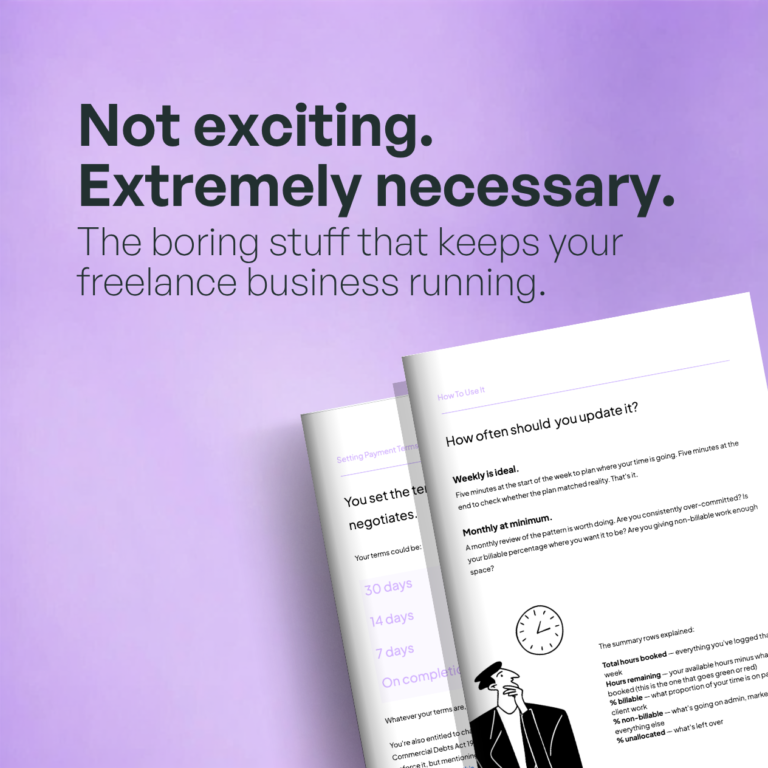
The capacity planner makes your time visible. You set your weekly hours once, add a row for each client or project, and fill in the hours you’re planning each week. Admin, marketing and time off get their own rows too, because they’re real hours. The planner adds it all up and shows you what’s left.
Green means you have capacity. Amber means you’re fully booked. Red means you’re over-committed and something needs to move.
If your planner is consistently red across multiple weeks, that’s not a time management problem. It’s a pricing or capacity problem. You’re either taking on too much at rates that don’t reflect how long things actually take, or you’re not leaving room for the non-billable work that’s an unavoidable part of running a freelance business.
Most freelancers are surprised by the gap between the hours they work and the hours they bill. Admin, emails, proposals and networking don’t go on an invoice, but they fill your week. The planner makes that visible so you can make better decisions about what you take on, what you charge, and when to say no.

5. Tools and software – what’s actually worth it
There are a lot of tools promising to make freelance life easier. Some of them actually do. Most of them are a distraction.
The tools and software guide covers 17 tools across invoicing and accounting, time tracking, project planning, client communication, file storage, and contracts – with honest notes on what each one is good for, who it suits, and what it costs.
But first, the guide addresses something more important: the Tool Rabbit Hole.
Trello → Monday.com → Asana → Notion → Motion
If that sequence looks familiar, you’ve been in it. Hours of YouTube tutorials. Building beautiful systems you open twice and abandon. The search for the perfect tool can become a very elaborate form of procrastination.
Before signing up for anything new, ask yourself: do I already have something that does this, even imperfectly? Will I actually use it, or am I excited about setting it up? Is the problem about the tool, or about the habit?
The guide helps you answer those questions honestly – and points you towards the tools worth actually paying for.
Everything in the kit
To be clear about what you’re getting:
- Invoicing guide + ready-to-use invoice template + invoicing checklist
- Income and expenses tracker (spreadsheet) + full guide + checklist
- Chasing invoices guide + 7 ready-to-use email templates + checklist
- Capacity planner (spreadsheet) + full guide + checklist
- Tools and software guide
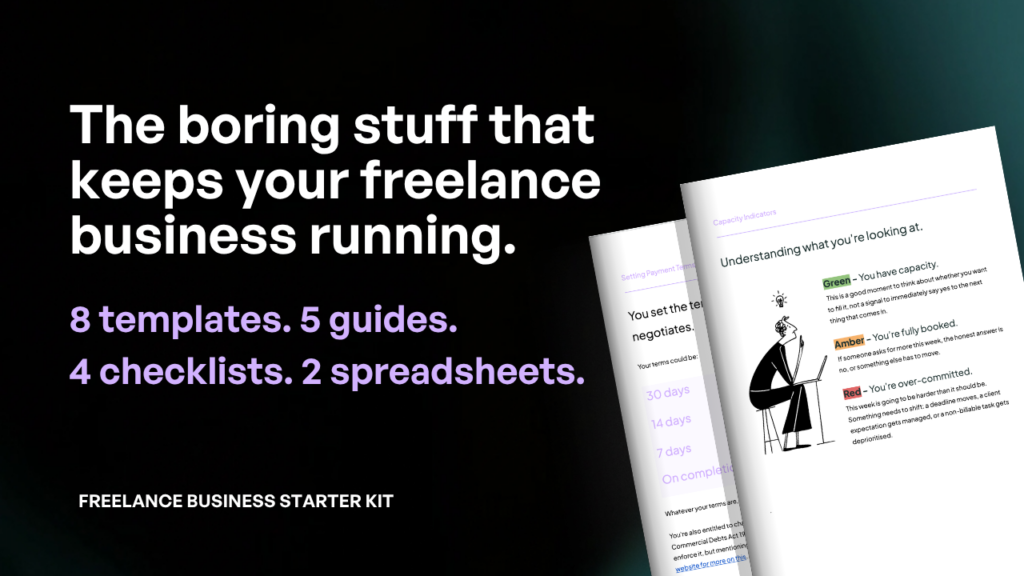
That’s 5 guides, 2 spreadsheet tools, 8 templates, and 4 checklists. Everything works independently – start wherever is most urgent.
£49. Available now on Gumroad.
Who this is for
This kit is for freelancers who are doing the work but haven’t fully got the business side sorted yet.
Specifically:
- You’ve been freelance for less than three years and are still figuring out the admin
- You know you should be tracking income and expenses properly but aren’t doing it consistently
- You have invoices you’re nervous to chase
- You keep saying yes to work without really knowing if you have the capacity
- You’ve lost time to the tool rabbit hole and want a straight answer about what’s worth using
It’s written for any freelancer who works with clients and invoices for their time, whether you’re a designer, copywriter, consultant, developer or VA.
Who this is NOT for
If you’re an experienced freelancer with solid systems already in place, this kit probably won’t tell you much you don’t already know. You’re not the audience.
If what you’re really looking for is community, peer support, and ongoing resources – templates, guides, events, and a network of people who get it – the kit isn’t the right fit. NEFN membership is.
Find out more about NEFN membership →
If you’re looking for accountancy or legal advice, this kit gives you the practical foundation and tells you when to bring in a professional. It doesn’t replace one.
A note on why this exists
I’ve been self-employed since 2018. For most of that time I did everything myself and kept going. Then I became a single foster carer, a four-year-old moved in, and I kept going – until I could feel the burnout coming. Running on fumes. Knowing something had to change.
What helped wasn’t a new app or a better system. It was making the boring stuff less hard. Having the templates ready so I wasn’t making decisions when I was already tired. Being able to see what my week actually looked like before I said yes to something.
That’s what this kit is. The practical stuff that should have come with the job.
Questions? You can find the NEFN community at northeastfreelancenetwork.co.uk or drop us a message.
Jade Gillham is a freelancer and founder of the North East Freelance Network (NEFN). She’s been self-employed since 2018, specialising in PPC and LinkedIn Ads.